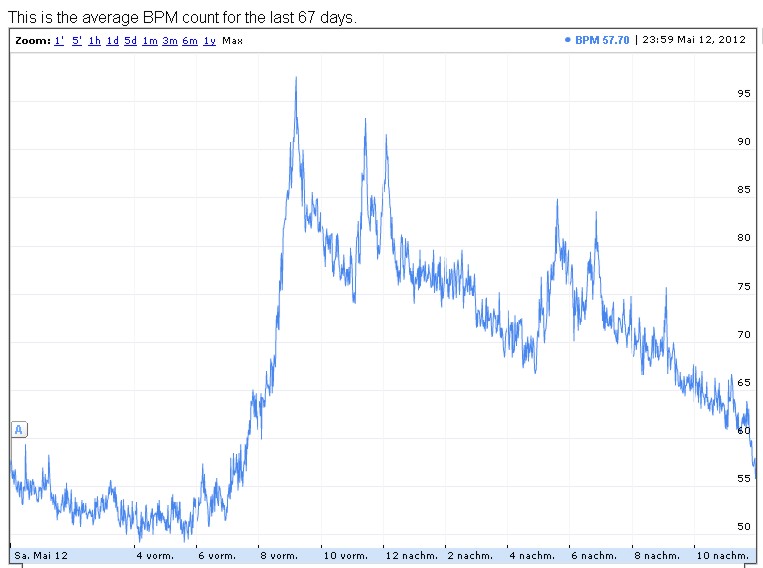
If you think heart rate graphs are boring, then look at these. This particular graph is taken from a ski trip of mine. My resting heart beat at night was about 50 beats per minute (bpm) and this value tripled, while skiing on the hills.


<!--
Name: stlvolume.php
Date: July 17, 20
-->
<?php
function stlhandling($volume=0,$toobig=0,$filepath){
$x_max = 0;
$y_max = 0;
$z_max = 0;
$x_min = 0;
$y_min = 0;
$z_min = 0;
//$filepath = "4.stl";
//$filepath = "k.stl";
$fp = fopen($filepath, "rb");
$section = file_get_contents($filepath, NULL, NULL, 0, 79);
$sizeoff=filesize( $filepath );
fseek($fp, 80);
$data = fread($fp, 4);
$numOfFacets = unpack("I", $data);
//echo $numOfFacets[1];
$pointer=12.5*$i+4;
$binary=1;
if(($numOfFacets[1]*12.5)>$sizeoff)$binary=0;
if($binary==0){fseek($fp, 0);
fgets($fp,100);
fgets($fp,100);
fgets($fp,100);
//echo "ascii";
}
echo $numOfFacets[1];
for ($i = 0; $i < $numOfFacets[1]; $i++){
//Start Normal Vector
if($binary==1){
$data = fread($fp, 4);
$hold = unpack("f", $data);
$normalVectorsX[$i] = $hold[1];
$data = fread($fp, 4);
$hold = unpack("f", $data);
$normalVectorsY[$i] = $hold[1];
$data = fread($fp, 4);
$hold = unpack("f", $data);
$normalVectorsZ[$i] = $hold[1];
//End Normal Vector
//Start Vertex1
$data = fread($fp, 4);
$hold = unpack("f", $data);
$vertex1X[$i] = $hold[1];
$data = fread($fp, 4);
$hold = unpack("f", $data);
$vertex1Y[$i] = $hold[1];
$data = fread($fp, 4);
$hold = unpack("f", $data);
$vertex1Z[$i] = $hold[1];
//End Vertex1
//Start Vertex2
$data = fread($fp, 4);
$hold = unpack("f", $data);
$vertex2X[$i] = $hold[1];
$data = fread($fp, 4);
$hold = unpack("f", $data);
$vertex2Y[$i] = $hold[1];
$data = fread($fp, 4);
$hold = unpack("f", $data);
$vertex2Z[$i] = $hold[1];
//End Vertex2
//Start Vertex3
$data = fread($fp, 4);
$hold = unpack("f", $data);
$vertex3X[$i] = $hold[1];
$data = fread($fp, 4);
$hold = unpack("f", $data);
$vertex3Y[$i] = $hold[1];
$data = fread($fp, 4);
$hold = unpack("f", $data);
$vertex3Z[$i] = $hold[1];
//End Vertex3
//Attribute Byte Count
$data = fread($fp, 2);
$hold = unpack("S", $data);
$abc[$i] = $hold[1];
}
if($binary==0){
//echo substr(fgets($fp,100),13);
$vertexarray1=explode(" ",substr(fgets($fp,150),13));
$vertexarray2=explode(" ",substr(fgets($fp,150),13));
$vertexarray3=explode(" ",substr(fgets($fp,150),13));
//echo "\n<br>k".floatval($vertexarray1[0]);
//echo "\n".fgets($fp,100);
$vertex1X[$i]=$vertexarray1[0];
$vertex1Y[$i]=$vertexarray1[1];
$vertex1Z[$i]=$vertexarray1[2];
$vertex2X[$i]=$vertexarray2[0];
$vertex2Y[$i]=$vertexarray2[1];
$vertex2Z[$i]=$vertexarray2[2];
$vertex3X[$i]=$vertexarray3[0];
$vertex3Y[$i]=$vertexarray3[1];
$vertex3Z[$i]=$vertexarray3[2];
fgets($fp,80);
fgets($fp,80);
$ko=fgets($fp,80);
//echo substr($ko,0,8)."\n<br>";
if(substr($ko,0,8)=="endsolid")$numOfFacets[1]=$i-1;//found the end of the file
fgets($fp,190);
}
$x_vals = array($vertex1X[$i], $vertex2X[$i], $vertex3X[$i]);
$y_vals = array($vertex1Y[$i], $vertex2Y[$i], $vertex3Y[$i]);
$z_vals = array($vertex1Z[$i], $vertex2Z[$i], $vertex3Z[$i]);
if(max($x_vals) > $x_max) {
$x_max = max($x_vals);
}
if(max($y_vals) > $y_max) {
$y_max = max($y_vals);
}
if(max($z_vals) > $z_max) {
$z_max = max($z_vals);
}
if(min($x_vals) < $x_min) {
$x_min = min($x_vals);
}
if(min($y_vals) < $y_min) {
$y_min = min($y_vals);
}
if(min($z_vals) < $z_min) {
$z_min = min($z_vals);
}
}
$x_dim = $x_max - $x_min;
$y_dim = $y_max - $y_min;
$z_dim = $z_max - $z_min;
$volume = $x_dim*$y_dim*$z_dim;
$raw_cost = 15;
$tray_cost = $raw_cost;
$material_cost = $raw_cost*$volume*1.02;
$support_cost = $raw_cost*2;
$total = $tray_cost + $material_cost + $support_cost;
echo "$".number_format($total, 2, '.', ',');
$fits=0;
if($x_dim<140 && $x_dim<140 && $z_dim<90)
$fits=1;
if($x_dim<140 && $x_dim<90 && $z_dim<140)
$fits=1;
if($x_dim<90 && $x_dim<140 && $z_dim<140)
$fits=1;
$volumeovercharge=$volume/30000;
$volumeovercharge=round($volumeovercharge,0);
//is volume < 0.5
if($volumeovercharge==0 && $volume>0)$volumeovercharge=1;
if($fits==0)$volumeovercharge=-1;
echo "\n<br>".$x_dim;echo "\n<br>";
echo "$".number_format($volume, 2, '.', ',');
echo "\n<br>".$y_dim;
echo "\n<br>".$z_dim;
echo "\n<br>".$fits;
echo "\n<br>k".$volumeovercharge;
return $volumeovercharge;
}
//stlhandling(0,0,"4.stl");
?>


\documentclass[12pt,a5paper,openany,oneside]{book}
\usepackage[a5paper]{geometry}
\usepackage[pdftex,pdftitle={book title},pdfauthor={Doe, John}]{hyperref}
\usepackage[pdftex]{color,graphicx}
\usepackage{graphicx,textcomp,booktabs,amsmath}
\usepackage{mathptmx,courier}
\usepackage[scaled]{helvet}
\usepackage{totpages}
\usepackage{amssymb}
\usepackage[utf8]{inputenc}
\textwidth 128mm
\topmargin -15mm
\textheight 175mm
\evensidemargin -15mm
\oddsidemargin -15mm
\begin{document}
%insert your text here
\end{document}
